What building a deep-tech startup in Thailand taught us
Notes on talent, customers and patience from nearly a decade of building AI from Bangkok.
BOTNOi Team
2 min read · Oct 12, 2026
Notes on talent, customers and patience from nearly a decade of building AI from Bangkok.

When BOTNOI started in 2017, the idea of a Thai company building its own AI models sounded ambitious to some people and naive to others. The common advice was to resell someone else's technology and focus on sales.
We chose the harder path. Here is some of what we learned.
Global AI companies are extraordinary at general problems. They are rarely obsessed with Thai tones, Thai business etiquette, or how a hospital in Chiang Mai actually schedules appointments.
That obsession is a startup's opening. Being close to the language, the culture and the customer lets you notice problems that look tiny from far away and are huge on the ground.
A great demo opens the door. It does not close the deal. Large organizations want to know that you will still exist in three years, that their data is safe, and that someone will pick up the phone when something breaks.
Certifications, security practices and boring documentation are not distractions from building. For enterprise AI they are part of the product.
A great demo opens the door. It does not close the deal.
The pool of experienced AI engineers in any one city is small. Some of our best people came from unexpected backgrounds and learned on the job. What they shared was curiosity and a willingness to stay with a hard problem.
Investing in teaching, through internships, university partnerships and an academy, turned out to be one of the best long-term bets we made.
Deep tech takes longer. Models need data, data needs customers, and customers need a product that works. The loop is slow at first and then compounds.
Startups do not usually die from competition. They die because they run out of time. Spending carefully, finding revenue early and choosing problems you can afford to solve is what buys you that time.
Southeast Asia has more than 650 million people and hundreds of languages. The region does not need to only import AI. It can build it, too.
Voice AI is rapidly shifting from robotic text-to-speech engines into fluid, real-time conversational systems. Here is why speech is emerging as the primary interface for the next generation of AI.
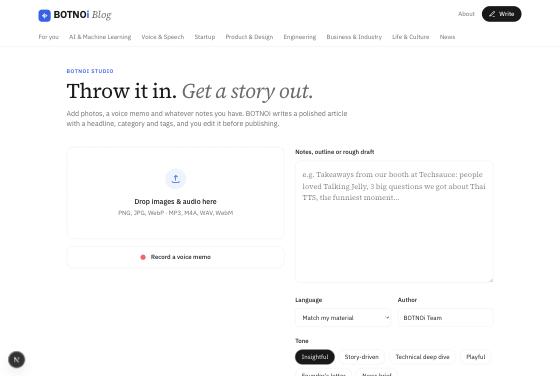
BOTNOI Blog เปิดตัวพร้อมเครื่องมือเขียนบทความที่ช่วยเปลี่ยน Voice Memo และรูปถ่ายดิบๆ ให้กลายเป็นเรื่องเล่าคุณภาพ เพราะหน้าที่ของ AI คือการทลายหน้ากระดาษว่างเปล่า ไม่ใช่การแทนที่เสียงของมนุษย์

ยินดีต้อนรับสู่ BOTNOI Blog พื้นที่รวบรวมเรื่องราว อัปเดตข่าวสาร และมุมมองเชิงลึกด้าน AI เทคโนโลยี และการขับเคลื่อนธุรกิจด้วยปัญญาประดิษฐ์