Why Voice Is Becoming the Ultimate Interface for AI
How low-latency speech synthesis and real-time models are reshaping human-computer interaction.
BOTNOi Team
3 min read · Nov 1, 2026
How low-latency speech synthesis and real-time models are reshaping human-computer interaction.
Imagine speaking to a computer and, for a fleeting moment, forgetting that you are interacting with software. The responses arrive with human-like rhythm, precise emphasis, and instant comprehension. There is no waiting for a cursor to blink across a screen, and no need to tap out text on a glass keyboard.
Voice AI is currently undergoing one of the most explosive shifts in technological history. What used to be a niche feature confined to simple phone trees and basic smart speakers is rapidly maturing into the default interface for modern artificial intelligence.
For decades, human-computer interaction has relied on visual tools: monitors, keyboards, mice, and touchscreens. While these interfaces allowed precise control, they required us to adapt to the machine's constraints. We had to learn syntax, navigate complex visual hierarchies, and sit down in front of devices.
Voice flips this dynamic completely. Speech is humanity’s most natural, high-bandwidth method of expressiveness. We can convey nuance, urgency, hesitation, and emotion in a fraction of a second through tone and cadence.
Voice is not just another feature added to an application; it is a fundamental shift toward software adapting to human biology rather than humans adapting to machine inputs.
As speech recognition accuracy crosses critical thresholds and voice generation engines produce natural intonation, the friction of communicating with complex systems vanishes.
Why is voice AI taking off right now? The transformation is anchored in three primary technological breakthroughs:
Real-Time Latency Reduction: Traditional voice pipelines used to chain three separate models together: Speech-to-Text (STT), a Large Language Model (LLM) for processing, and Text-to-Speech (TTS) for response output. This multi-step process introduced seconds of delay, destroying natural conversation flow. Breakthroughs in model orchestration and end-to-end multimodal architectures have sliced response times down to sub-500 milliseconds, mirroring natural human conversation rates.
Context-Aware Prosody and Emotion: Modern text-to-speech systems no longer sound like monotone synthesizers reading a database. Today’s models process punctuation, context, and semantic meaning to infer natural pauses, pitch variation, and emotional resonance.
Multilingual and Cross-Cultural Fluency: High-quality voice engines now support dozens of languages and regional accents natively, allowing localized AI agents to serve global audiences without losing cultural context.
Businesses are moving away from traditional Interactive Voice Response (IVR) systems—the frustrated "Press 1 for customer support" experiences of the past decade—toward intelligent conversational agents.
Modern Voice AI agents can perform complex operational tasks in real time: booking reservations, assisting in multi-lingual customer service calls, triaging support tickets, and even providing real-time language translation during live calls. They do not just recognize words; they understand intent, retain context across turns, and take meaningful actions within backend workflows.
In healthcare, voice interfaces allow doctors to dictate patient notes hands-free during procedures. In retail and logistics, hands-busy, eyes-busy workers can query inventory databases using simple spoken prompts while staying focused on physical tasks.
As voice interfaces become ubiquitous, product teams must rethink how software is designed. User experience design will no longer be solely about visual layout and visual aesthetics. Instead, audio UX, conversational turn-taking, clarity, and tonal personality will dictate how users evaluate products.
The transition to voice-first computing will not render screens obsolete, but it will fundamentally change our default interaction habits. The best interfaces are the ones that disappear entirely—and nothing disappears more gracefully than a voice conversation.

Thai looks simple on a phone screen and is brutal for a speech engine. Here is what makes it hard, and what it takes to make an AI voice that sounds like a person.
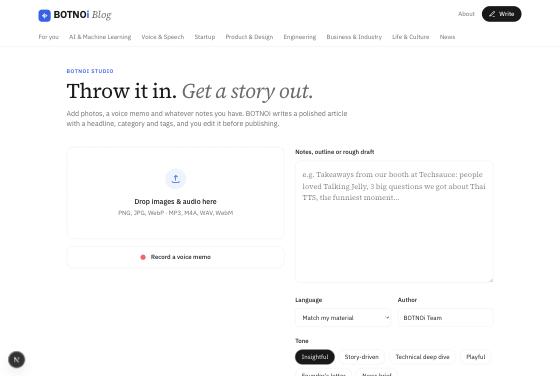
BOTNOI Blog เปิดตัวพร้อมเครื่องมือเขียนบทความที่ช่วยเปลี่ยน Voice Memo และรูปถ่ายดิบๆ ให้กลายเป็นเรื่องเล่าคุณภาพ เพราะหน้าที่ของ AI คือการทลายหน้ากระดาษว่างเปล่า ไม่ใช่การแทนที่เสียงของมนุษย์

ยินดีต้อนรับสู่ BOTNOI Blog พื้นที่รวบรวมเรื่องราว อัปเดตข่าวสาร และมุมมองเชิงลึกด้าน AI เทคโนโลยี และการขับเคลื่อนธุรกิจด้วยปัญญาประดิษฐ์