What a voicebot can (and should not) do in a hospital
Appointment reminders at scale, without losing the human touch where it counts.
BOTNOi Solutions Team
1 min read · Sep 30, 2026
Appointment reminders at scale, without losing the human touch where it counts.

Picture the phone desk at a busy hospital on a Monday morning. Dozens of calls to confirm appointments, remind patients to fast before a test, follow up after a discharge. Each call is short, important and repetitive.
This is exactly the kind of work a voicebot is good at, and exactly the kind of setting where getting it wrong has real consequences.
Each of these is structured, high-volume and easy to measure. Staff get hours back every week.
A voicebot should never be the last line for anything clinical or emotional. If a patient sounds distressed, mentions a symptom, or simply asks for a person, the system needs to hand over to a human immediately, with the context already filled in.
Design for the patient first. The efficiency follows.
Patients should always know they are talking to an automated assistant. The voice should be calm and clear, the questions short, and the way out to a human obvious.
Done well, a voicebot does not make a hospital feel less human. It frees the humans to be there for the calls that really need them.
Voice AI is rapidly shifting from robotic text-to-speech engines into fluid, real-time conversational systems. Here is why speech is emerging as the primary interface for the next generation of AI.
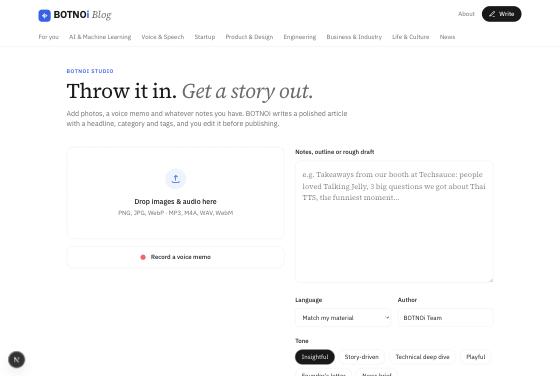
BOTNOI Blog เปิดตัวพร้อมเครื่องมือเขียนบทความที่ช่วยเปลี่ยน Voice Memo และรูปถ่ายดิบๆ ให้กลายเป็นเรื่องเล่าคุณภาพ เพราะหน้าที่ของ AI คือการทลายหน้ากระดาษว่างเปล่า ไม่ใช่การแทนที่เสียงของมนุษย์

ยินดีต้อนรับสู่ BOTNOI Blog พื้นที่รวบรวมเรื่องราว อัปเดตข่าวสาร และมุมมองเชิงลึกด้าน AI เทคโนโลยี และการขับเคลื่อนธุรกิจด้วยปัญญาประดิษฐ์